Spring Fashion Korea ã…â¡ã«â€˜â ë≠ìå¾â¬ã£â€¦â¡ã«â€˜â
I've already posted about the difference betwixt swiss waists, waist cinchers, corsets & corselets. Â This week, I'yard going back in history, and dorsum to basics, to hash out the differences between stays, jumps & corsets.
Stays, was the term used for the fully boned laces bodices worn under apparel from the late 16th or early 17th century, until the end of the 18th century. Â Before this boned garments were called (in English at least) a 'pair of bodies' – for each side of the stays.
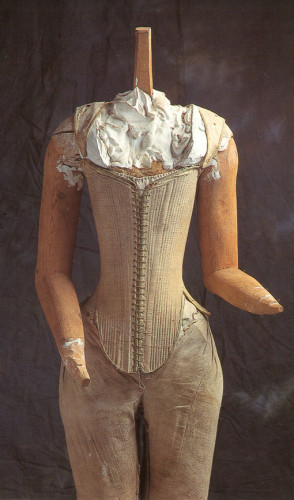
Extant stays (Queen Elizabeth's effigy bodies) ca. 1603
via here (only if anyone knows the original source I'd prefer to credit it!)
The term stays probably comes from the French estayer: to support, because that is exactly what stays did. Â Stays turned the torso into a potent, inverted cone, raising and supporting the bust, and providing a solid foundation on which the garments draped. Â Despite their heavy boning, and how stiff and constricting they may seem to modern eyes, stays were originally seen every bit more than informal wear, as opposed to garments with the boning congenital in, such as the robe de cour.
Stays were more than commonly worn in England than in France. Â 18th century visitors to England consistently commented on how even the peasants wore stays, though they might just have one pair (often leather) which was worn constantly without washing.
In France the peasants, in general, announced to have gone without stays, and even among the aristocracy stays, though commonly worn, were just mandatory at formal courtroom functions. Â Even and then, a lady could be excused from wearing them if her health made them inadvisable. Â Throughout the 18th century there were fashions that immune women to go stayless: the robe battante could disguise an un-supported torso, though wearing 1 likewise long might crusade rumours of pregnancy or simply create an impression of slovenliness and laxity of morals. Â Stays were a literal symbol of a woman'due south uprightness and virtue.
In addition to meaning the garment itself, the term 'stay' could refer to the boning inside a garment, so each os is, in itself, a stay. Â In 1688 Randal Holme described a mantua as "a sort of loose coat without whatever stays in it."
Jumps were softer, significantly less boned (and sometimes completely unboned), bodices or soft stays which still provided some bust support, just did not shape the trunk into such a 'elegant' cone shape. Â They laced upwardly the front, and thus were easier for a lady to put on and have off by herself.
Originally used for breezy wear at the first to the of the 18th century, they were worn throughout the century as a more comfortable culling to stays, and  became more popular at the stop of the century with the change in fashion from the elaborate 18th century styles to the softer neoclassical styles.
Jumps had an interesting public image. Â On one mitt, they were promoted as a healthier alternative to stays by doctors and others who felt that too restrictive stays were unhealthy. Â In 1740 Mrs Delaney wrote to her sister imploring her not to lace tightly, and sending a pair of jumps for her to habiliment instead. Â On the other, a woman in jumps was less impeccably dressed, and thus less morally impeccable, in stays. Â A 1762 verse form describes a woman as "Now a not bad shape in stays, now a slattern in jumps."
As the fashions inverse and the popularity of jumps rose, other forms of soft undergarments also evolved. Â Among these was the corset.
Corset, like corsage, comes from the French term for a trunk (corps) and the term was first used in France in the 1770s (though at that place had been an earlier Medieval/Renaissance usage of corset which described a decorative sleeveless bodice).  In 1777 a corset was described (in French) as "a footling pair of stays usually fabricated of quilted linen without basic that ladies spike in front with strings or ribbon and that they vesture in deshabille."
By the 1780s the term had reached England via way writers describing the new French garments equally 'a quilted waistcoat which is chosen un corset, without whatsoever kind of stiffening."
It's quite clear in early on writings that corsets were significantly softer and less structured than stays. Â An Englishwoman visiting Paris in 1802 wrote home about Paris fashions: "THREE petticoats? Â No i wears more than ane! Â STAYS? Â Every body has left off fifty-fifty corsets."
The one problem with terms like 'jumps' and 'corset' is that we're not always sure which garments would take been called what at each decade. Â Fashion has always been a spectrum, and it is quite likely that one adult female might accept a garment which she would phone call jumps, while some other would call the particular a corset. Â The yellow waistcoat posted in a higher place is a adept example. Â Garments that fit an identical description are described equally jumps in the mid-18th century, but so are significantly more structured undergarments. Â Modernistic costume historians sometimes use terms like 'transitional stays' to describe the garments between heavily boned stays and the longline corsets of the 1810s etc, simply of class this is non a term that would ever have been used in-period.
Other terms of supportive undergarments seen as fashion went through a series of massive chances in the last decades of the 18th century and the first decades of the 19th were (in roughly chronological order)Âshort stays (for short, lighter boned stays),Âbust bodices (for boned, wrapped proto-bras) and demi-corsets (shorter, lightly boned corsets used for breezy vesture).
Every bit waistlines dropped in the late 1810s, boning returned to undergarments.  Corset, all the same, remained in apply as a term for supportive undergarments, but now referring to the more boned, waist-cinching undergarments, rather than the soft waistcoats they had originally indicated.  Stays and corsets were used quite interchangeably in the early decades of the 19th century.  A training transmission for ladies maids written in 1825 describes the garments as "…stays, corsets, or whatsoever other proper name may exist given to the stiff casing that is employed to shrink the upper office of the body".
Equally the 19th century progressed, corset became the more common term for the boned, laced garment, merely the term stays remained in common usage,  both for the garment, and fifty-fifty more than and then, for the actual pieces of bone in the corset.  There are frequent uses of the term 'stays' as a synonym for corsets into the early 20th century, sometimes for its pun potential, with amusingly dreadful results.
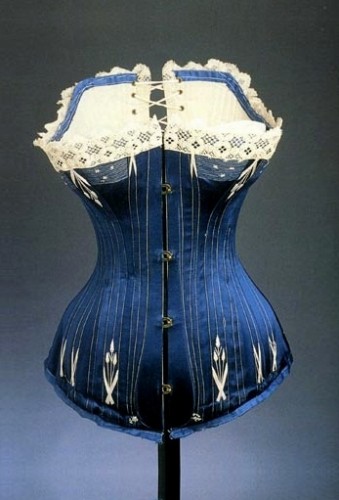
Corset in blue silk, circa 1890
The link betwixt lacing and propriety likewise remained, though in a less obvious course.  A relatively balanced 1889 discussion on corsets describes a laced figure as "bully and tidy" and an unlaced figure equally "loose and negligé."
It has only been in the 20th and 21st centuries, long past the days of constrictive undergarments being commonly worn, that we have abandoned the word 'stays' equally a synonym for corset. Â Equally historical costumers we use 'stays' almost exclusively every bit a term for 17th & 18th century boned undergarments, only historically speaking we would be only as correct to say "my new stays are the well-nigh comfortable pair I've made notwithstanding" nigh an 1880s corset.
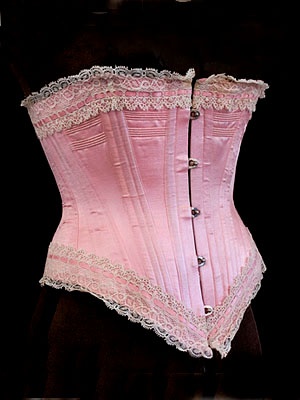
Pinkish satin corset, c.1890, Vintage Textile
Sources:
Baumgarten, Linda. ÂEighteenth Century Article of clothing at Williamsburg. Â Williamsburg: Colonial Williamsburg. Â 1986.
Bulcock, J. The Duties of a Lady'south Maid;: With Directions for Bear, and Numberous Receipts for the Toilette. Â Google eBook. Â Retrieved 26/viii/13
Cumming, Valerie and Cunnington, C.Due west.; Cunnington, P.Eastward,ÂThe Dictionary of Fashion History (Rev., updated ed.). Oxford: Berg Publishers. 2010
Delaney, Mary. Autobiography and Correspondence of Mary Granville, Mrs Delany: With Interesting Reminiscences of Male monarch George the 3rd and Queen Charlotte. Â Cambridge: Cambridge University Press. Â 2011.
Steele, Valerie. ÂThe Corset: A Cultural History. Â Yale Academy Press: London. Â 2001.
Steele, Valerie (ed). ÂThe Berg Companion to Fashion. Â Oxford: Berg Publishers. Â 2010
Vincent, Susan. The Anatomy of Fashion: Dressing the Body from the Renaissance to Today. Â Oxford:ÂBerg Publishers. Â 2009
0 Response to "Spring Fashion Korea ã…â¡ã«â€˜â ë≠ìå¾â¬ã£â€¦â¡ã«â€˜â"
Post a Comment